 Good Neighbour
Accuracy matters more than filling every box.
You don’t need to be a property expert. A useful enquiry describes the home as it is, including its advantages and any concerns. “Not sure” tells us where to ask a follow-up question; a guessed answer can send the assessment in the wrong direction. A few reliable details are more helpful than a long description built on assumptions.
Preparing information early is also useful beyond our service: the government’s selling guide explains how gathering paperwork at the outset can help avoid delays. Read the GOV.UK selling guide.
Two bedrooms can describe very different homes.
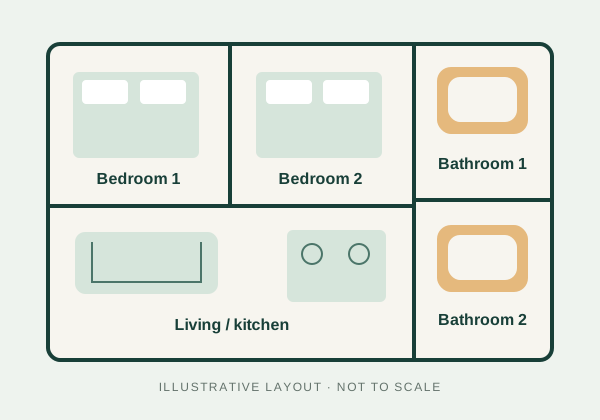
Imagine you describe a flat simply as “two bedrooms”. That leaves us asking about floor area, bathrooms, layout, condition and tenure. If it also has a second bathroom or private outdoor space, those are features we should know about.
We consider the property as a whole, alongside local evidence. A second bathroom may influence the assessment; it doesn’t add a fixed amount or guarantee a higher offer. Its usefulness, the overall layout and comparable homes all matter. Equally, a converted loft should be described separately if its approval or bedroom status is uncertain.
Share repairs as well as improvements.
“Kitchen replaced in 2024; a roof leak still needs attention” gives us a clearer starting point than “fully refurbished”. Describe what you know, where an issue occurs and any assessment or repair already carried out. You don’t need to diagnose it or inspect somewhere unsafe.
The government guide notes that defects discovered later can lead to further price negotiations. Raising known issues early lets them be considered in the initial discussion. It cannot rule out discoveries during later checks. GOV.UK: preparing your home and information for sale.
Use documents to support the picture.
- Floor plan: helpful for understanding room arrangements and stated dimensions. Tell us if it predates an extension or conversion.
- EPC: provides information about energy performance. It is not a substitute for an assessment of the home’s condition. GOV.UK explains EPCs.
- Survey or report: can flag findings and recommended investigations. Include the date and tell us about work done since. Different survey levels cover different things; a valuation alone is not a condition survey. RICS explains home surveys.
Our enquiry lets you select optional PDFs or images, or choose to add them later. You can start without documents. Only share files you’re entitled to provide, and leave out unrelated personal or financial records.
Clearer information helps when timing matters.
Early answers can reduce the questions we need to come back with. They can also help us identify what still needs checking before discussing a realistic timetable. They don’t guarantee a faster completion: legal work, access, evidence and the individual transaction still matter.
Our purchase offer and an open-market valuation are different things. A direct purchase also reflects the terms and circumstances of the transaction. Compare your selling routes and the net proceeds, rather than assuming the quickest route offers the highest price. Explore your options.
Openness is our responsibility too.
Giving accurate information is not a promise that you know about every hidden problem. Nor does a missing detail automatically justify a price reduction. A buyer should explain what has changed, why it matters and how it affects the proposed figure.
If we propose a change, we’ll explain the reason and relevant evidence, identify what checks remain and give you room to ask questions. MoneyHelper advises sellers to obtain written terms and request the survey findings if those are given as the reason for a reduced offer. Read MoneyHelper’s independent quick-sale guidance.
A late price reduction is often called gazundering. It is not always caused by inaccurate seller information: it can also reflect a buyer’s changed position or negotiating tactics. Read our guide to a buyer reducing their offer.
Sources and review
Sources checked 26 October 2026. This article explains our enquiry approach and provides general information; it does not replace advice about your particular property or contract.